Within the demanding realm of modern pro-level oversteer competition, success is no longer purely a product of brute torque or driver aggression. Conversely, it has become a multifaceted engineering challenge that demands a meticulous blend of picking a time-tested chassis, arming it with the most precise competition parts, and, most critically, understanding its real-time behavior on the course through sophisticated suspension tuning applications. This comprehensive guide acts as your master plan starting from the initial concept of a drift build right through to the final data-informed tweaks that elevate a strong machine into a repeatable champion. We will examine in detail the art and science of car suspension tuning, demonstrating how a modern vehicle dynamics tool like precise measurement hardware removes guesswork and offers exceptional visibility into your vehicle's true behavior.
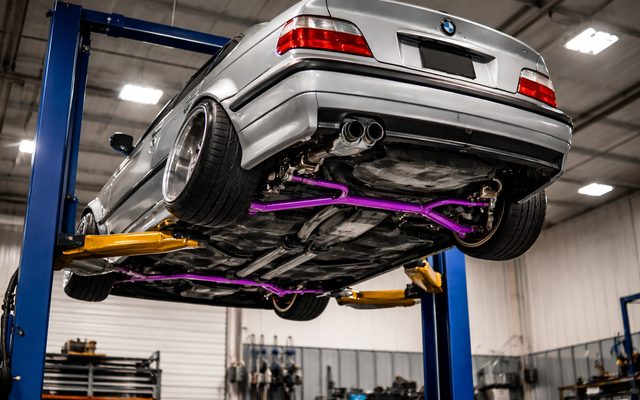
The bedrock of any exceptional drift car is, undoubtedly, the chassis itself. Certain platforms have attained renowned status within the worldwide oversteer culture due to their built-in balance, strong construction, and the enormous ecosystem of aftermarket components available. Selecting the right car is the first and most crucial choice a builder will make. As an example, the the E36 generation BMW is widely regarded as among the finest overall drift cars of the modern era. Its excellent 50/50 weight distribution, alongside a RWD setup and robust inline-six powerplants, creates a chassis that is both accessible for newcomers and extremely effective in the possession of a professional competitor. The successor of this concept, the BMW E46 platform, refines these qualities with a even more developed chassis, wider track for enhanced high-speed stability, and yet increased steering angle as standard from the OEM. A distinct powerful contender in the professional arena is the Chevrolet Corvette C6.
This V8-powered track weapon offers a unique combination of benefits to the sliding world, featuring a lightweight aluminium chassis, a transaxle-style gearbox and differential unit that helps create an ideal balance, and the immense thrust of a powerful LS V8 motor. This fusion renders it an complete monster on track, able of starting and sustaining continuous drifts with seemingly minimal application of acceleration. For drivers desiring outstanding bang-for-the-buck, the Nissan Z33 stands out as a top-tier example. It comes from the factory with a rigid platform, a decent factory limited-slip differential, and the responsive VQ series powerplant that provides sufficient power and torque for practicing and advancing in the discipline. Its successor, the 370Z model, brings more improvements in structural rigidity, handling precision, and overall powerplant power, solidifying its place as a popular choice among competitive drivers. Other iconic vehicles that merit attention include the agile rotary-powered FC generation RX-7, the most popular Nissan S13, the American SN95 generation Mustang, the more recent E90 3 Series, and the compact yet incredibly engaging and teachable Mazda Miata. Every single one of these chassis gives a unique palette of attributes, complexities, and capabilities, but they all have in common the basic components essential to serve as a competitive sliding vehicle.
However, picking the correct chassis is merely the beginning. To unlock the full performance of any of these cars, significant upgrades to the steering system and suspension systems are absolutely non-negotiable. This is where the world of performance aftermarket parts comes into critical focus. The one most impactful modification for a serious competition vehicle is the installation of a high-performance steering angle kit. These engineered systems, like those engineered by industry leaders like SLR, are created to dramatically enhance the chassis's maximum steering angle. A OEM production vehicle is severely limited in how far its tires can rotate, a engineering trade-off for daily use. In sliding, conversely, maximum countersteering is frequently necessary to control and maintain a angle. An angle kit exchanges the stock steering knuckles, rod ends, and potentially suspension arms with pieces that permit the wheels to achieve angles beyond 70 or even 80 °, as opposed to a normal stock angle of around 40 to 50 degs.
This immensely increased lock gives the pilot with exponentially more authority during a slide, enabling it to be considerably more straightforward to start a oversteer moment, sustain it through a extended turn, and switch fluidly from one side to another. The improvement in controllability is truly revolutionary. Combined with a correctly chosen modification is the just as essential modification to the vehicle's damping system. Generic or even premium sport adjustable suspension are generally not intended for the particular and harsh needs of sliding. A purpose-built system of coilovers is of utmost importance. These specialized coilovers incorporate unique valving and spring stiffness that are tuned for the violent mass transition that is characteristic of drifting. When a operator starts a drift, the vehicle's mass is transferred forcefully to the front of the corner. Optimal performance dampers handle this shift in a consistent manner, enabling the vehicle to settle rapidly and giving the pilot precise feel through the wheel and cockpit. They furthermore allow for precise adjustment of ride height, rebound and compression stiffness, and weight balance, which are all fundamental elements of optimizing the vehicle's handling to a particular circuit or piloting approach. As a system, a high-quality steering angle kit and a expertly specified set of performance adjustable dampers are the core physical cornerstone upon which all subsequent optimization is built.
Once the fundamental parts is fitted, the next vital phase in the build is the detailed adjustment of the car's alignment. This is the realm of chassis dynamics adjustment, a procedure that can feel intimidating to the uninitiated but is, in fact, the secret to transforming a set of high-performance components into a harmonious and consistent vehicle. The most debated parameter of alignment for oversteer is certainly negative camber. Camber angle is the angle of the tire relative to the upright axis when observed from the front-on of the vehicle. When the top edge of the wheel is angled inward, this is known as camber-in. For oversteer driving, negative camber on the steering wheels is universally employed and is seen as critical. The reason is deeply related to vehicle dynamics.
When a chassis is cornering at extreme slip angles, the frame rolls to the external of the bend. This lean makes the outer front wheel to diminish its ideal footprint with the tarmac. By adding an inward tilt, the wheel is pre-angled to account for this roll. As the chassis tilts into the bend, the outside front tire flattens out against the asphalt, optimizing its traction at the exact time when it is absolutely essential for steering authority. Typically, front camber settings for a competition drift car fall between approximately -3 degrees to as high as -5 degrees or even greater, based on the parameters of the car configuration, rubber selection, and driver preference. The rear wheels also use inward lean, but the angles are usually more conservative and subtler than the front axle. Overly aggressive negative camber at the back can make the car excessively tail-happy and hard to control on acceleration application, as it reduces the usable grip area of the powered wheels during forward throttle application. Hence, rear adjustments are frequently in the range of -1 degree to -3 degrees, striking a precise compromise between giving sufficient side traction to aid in entering and sustaining the angle while still maintaining usable hook-up for acceleration the corner. camber angle is merely one element of the more complex alignment picture, which additionally involves toe angle, caster, and bump steer adjustment.
Toe angle refers to the direction of the tires when viewed from the top. Toe-in means the front edges of the wheels are closer together than the trailing edges, while outward toe means the reverse. For sliding, a small amount of front negative toe is often employed to improve the turn-in handling feel, making the car feel more responsive and eager to initiate a oversteer moment. Rear axle toe setting is generally set to zero or a very slight amount of toe-in to promote predictability under power. self-centering is the longitudinal or aft inclination of the suspension pivot when observed from the side of the vehicle. More caster enhances feedback and stability stability, and it furthermore boosts camber increase during turning, which is extremely useful. Adjusting these parameters is a detailed interplay where a adjustment to a single setting can and will affect the other settings. The conventional approach for tuning a chassis's suspension geometry for competition has long been a labor-intensive process of trial and error. A pilot or team would make a modification based on experience, test the chassis on track, rely on the driver's individual perception and feedback, and then apply an additional change. This cycle would iterate again and again until the chassis felt "good" or the available practice session ended. This methodology is not only exceptionally inefficient in terms of man-hours and tires, fuel, and parts, but it is furthermore fundamentally flawed.
Driver sensation is a infamously inconsistent measurement tool, influenced by numerous factors such as fatigue, evolving track grip levels, temperature, and simply the focus of the pilot on that given run. What feels "loose" on one lap might feel "understeery" on the subsequent pass, causing contradictory information and frustrating changes. This age-old problem in car suspension tuning is precisely where modern telemetry systems has stepped in to completely change the process.
The advent and integration of specialized vehicle dynamics tools has ushered in a radically different paradigm for engineering and refining high-performance drift machines. This new generation of platforms, exemplified by groundbreaking systems like modern telemetry hardware, function by directly recording the real-time mechanical movement of the car as it is being driven on the track. Unlike depending on driver feedback, these suspension tuning tool devices gather quantifiable information on critical factors such as shock absorber movement, individual tire rotation, G-force loading, lock position, and driver input input. This raw telemetry is then analyzed by advanced algorithms that can plot and decode the information in a comprehensible manner. For the first time ever, tuners and crews can visualize exactly what the vehicle is performing at any given point of a lap. This capability changes the entire alignment optimization process. Imagine the specific challenge of dialing in the front axle negative camber for a particular vehicle. Instead of making a change from -3 degrees to -3.5 degrees and then running several laps to try and "feel" a change, a suspension tuning tool can give immediate and definitive data. The tool can display visually how the suspension's contact patch is acting during the most important stages of a angle: initiation, sustain, and changing direction. It can show if the existing camber setting is permitting the loaded tire to achieve optimal contact or if the rubber is working inefficiently on its outside edge.
The system can then provide fact-based advice for modification. Perhaps the data shows that the tire is still overloading its outer shoulder at -3.5 degrees of negative camber, suggesting that an increase to inward lean, say -4 degrees, might be beneficial. On the other hand, the data might show that the tire is failing to reaching temperature or that the inside shoulder is degrading excessively, which could indicate that there is overly aggressive inward lean and a small lessening back to -3.2 degrees would be more optimal. This degree of precision and actionable intelligence was simply impossible in the era of solely seat-of-the-pants tuning.
The benefit of using a dedicated suspension tuning tool extends well beyond just setting camber angles. It becomes an essential damper adjustment manual that is specific to your exact vehicle. When adjusting the damping clickers on your adjustable dampers, rather than using imprecise tips or mimicking another driver's setup, you can employ the data to see how the vehicle is reacting in reaction to your adjustments. The application can graph the wheel movement trace over a section of track, highlighting if the shocks are managing the weight transfer optimally or if they are causing the chassis to become unsettled uncontrollably after a flick. It can help in pinpointing problems like bottoming out or topping out, allowing you to introduce data-backed choices to preload settings, damping settings, or ride height. This methodology applies just as well to the complex process of corner balancing. Beyond camber angle, the software can give data into how changes to toe and caster are impacting the chassis's handling during various parts of a drift. For instance, it can allow you to ascertain the best amount of front axle toe out for your specific steering rack configuration and competition approach by showing the response time of turn-in response and the predictability of the car at full countersteer. This turns the tool an incredibly useful drift suspension tuning guide that is constantly updated by the real-world performance of your own car on the circuit. It elevates the complete endeavor from a subjective skill into a repeatable engineering exercise.
Furthermore, the utility of a system like GripDial is not at all confined to expert teams with vast funding. For the club-level enthusiast, it serves as an powerful force multiplier. It practically offers the builder with the knowledge of a full-time dynamics engineer without needing the associated expense. It speeds up the learning curve by giving definitive answers to challenges that would traditionally take years of trial and error to answer. A builder can learn how their particular chassis reacts to various settings, building a more intuitive knowledge of vehicle dynamics in the endeavor. It additionally democratizes high-level chassis dynamics concepts, allowing all drivers with the drive to optimize their machine to accomplish it in a systematic and successful way. This is notably important in a sport like sliding, where tuning knowledge has traditionally been a closely guarded commodity among elite drivers. In the modern era, that power can be in the toolkit of any serious driver.
In the final analysis, the journey to engineering and tuning the perfect championship-contending drift machine is a multi-stage endeavor that perfectly blends time-honored mechanical knowledge with revolutionary digital solutions. It commences with the strategic choice of a proven car, then built upon the application of essential competition components like high-performance steering angle kits and properly selected performance coilovers. The journey then moves into the intricate phase of chassis dynamics adjustment, where parameters like negative camber, toe, and caster are precisely adjusted to suit the vehicle's new capabilities and the operator's specific technique. Finally, and what truly distinguishes the contemporary process from the past, is the integration of a powerful suspension tuning application. This platform eliminates the uncertainty and inefficiency of solely feel-based tuning by giving empirical, real-time telemetry on how the car is truly behaving. It functions as an indispensable engineering partner, a comprehensive drift suspension tuning guide, and a all-in-one vehicle dynamics tool. As a complete package, this complete philosophy ensures that each and every component of the drift machine—from the selection of the car to the most minute tweak on the suspension—is optimized for peak performance on the circuit. It represents the full maturation of the drift telemetry software discipline of oversteer driving, bridging raw car coilover setup tips control with precise suspension engineering to build the most dominant cars imaginable.